
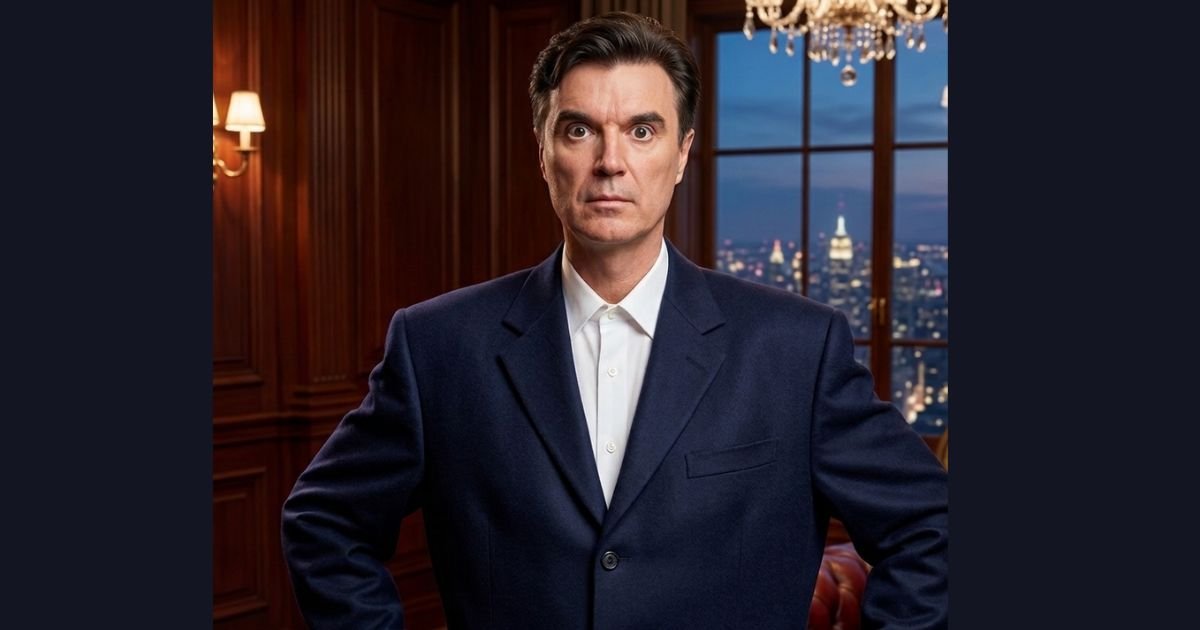
Imagine stepping into a darkened theater in 1984. The screen lights up with a skinny guy in a plain gray suit, alone on stage with nothing but a boombox and a lamp. He presses play, and the music starts simply. Then the band joins one by one. The stage grows. The energy builds. And suddenly, there it is: David Byrne emerges in the biggest, boxiest suit you have ever seen. His head looks tiny atop this massive rectangular frame. He dances like a marionette come to life, arms flailing, hips swinging, the fabric rippling in waves. The crowd loses it. You might too. That moment, captured in Jonathan Demme’s Stop Making Sense, turned David Byrne’s big suit into one of rock’s most unforgettable visuals.
Plenty of performers chase spectacle with lights, pyrotechnics, or wild outfits. Byrne chose something subtler yet bolder. He took the everyday business suit and blew it up to cartoon proportions. The result? Pure theater that still sparks questions decades later. Why did he wear it? How did they even build the thing? And what does it say about performance, identity, and the power of exaggeration? Let’s dig in.
Table of Contents
- The Spark of Inspiration: Where the Big Suit Idea Came From
- Crafting the Icon: How the Big Suit Was Actually Made
- Stepping Into the Spotlight: The Suit in Stop Making Sense
- Layers of Meaning: What the Big Suit Symbolized
- From Concert Stage to Cultural Phenomenon: Lasting Impact
- Comparison: The Big Suit Versus Other Iconic Stage Costumes
- FAQ
- Wrapping It Up: Why This Look Endures
The Spark of Inspiration: Where the Big Suit Idea Came From
David Byrne has never been one for flashy rock-star excess. Early on with Talking Heads, he experimented with neutral looks to let the music do the talking. Think button-up shirts and rolled sleeves. Suits came later, partly as a practical choice. Walking New York streets, he noticed businessmen in plain gray outfits. They blended in. No statement, just uniform. Perfect for a band that wanted the sound front and center.
But for the 1983 tour promoting Speaking in Tongues, Byrne wanted more. A fashion-designer friend dropped a casual line: in theater, everything needs to be bigger. Gestures, movements, the whole vibe. Byrne took it literally. Around the same time, he traveled to Japan and soaked up traditional forms like Noh and Kabuki. Those performances feature oversized, geometric costumes. The effect? A performer’s head appears small against a broad, rectangular silhouette. Front-facing and striking. You might not know this, but Byrne sketched the idea himself, a boxy businessman’s suit pushed to extremes.
The deeper reason ties straight to the music. As Byrne has explained in interviews, music hits the body first. The head catches up later. “I wanted my head to appear smaller,” he once said, “and the easiest way to do that was to make my body bigger.” It even plays with the band’s name. Talking Heads. Suddenly, the body becomes this exaggerated frame, and the head, well, it really does the talking. Some experts disagree, but here’s my take: this wasn’t random weirdness. It was smart performance art that turned a simple suit into a statement about how we experience art physically.
Crafting the Icon: How the Big Suit Was Actually Made
Turning that sketch into reality fell to costume designer Gail Blacker. She didn’t approach it like regular clothes. Blacker called the project more of an architectural endeavor than fashion. The suit had to hold its shape under hot lights and wild dancing without restricting movement.
Here’s where it gets clever. An internal framework did the heavy lifting: webbed shoulder pads and a girdle-like structure around the waist. Needlepoint canvas lined the fabric to keep everything stiff and angular. The actual suit material hung loosely from this scaffolding. Most of it never even touched Byrne’s body. It draped and swayed with every step. Face the side, and he looked almost normal. Turn front, and boom, incredibly wide. The gray color helped too. It photographed well under stage lights and matched the neutral tones the rest of the band wore for a seamless visual.
You can picture the fitting process. Byrne stepping in, adjusting the frame, testing the dance moves. The jacket got so warm he often shed it after one song, but the pants stayed. Blacker’s work made the impossible practical. Honestly, this isn’t talked about enough, but without that engineering, the suit would have collapsed or trapped him. Instead, it amplified his quirky, jerky style. The fabric moved like it had a mind of its own.
Stepping Into the Spotlight: The Suit in Stop Making Sense
Stop Making Sense isn’t your typical concert film. Demme shot it over multiple nights in 1983, building the show piece by piece. Byrne opens small and solo. No big production at first. As songs roll and band members arrive, the stage fills. Then comes the big reveal during “Girlfriend Is Better,” the track that gave the movie its title.
Byrne steps out in the suit, shadow first on the backdrop. The camera pulls back. There he is, this larger-than-life figure. He dances with total commitment, shoulders shrugging, arms pumping. The suit ripples and flows. It looks absurd yet mesmerizing. Pauline Kael, writing for The New Yorker, nailed it. She called Byrne a “handsome, freaky golem.” The suit didn’t just follow his moves. It seemed to lead them.
The film turned the moment into legend. Viewers walked away quoting that image. Byrne only wore the full suit for part of the show, but it defined the whole experience. The tour itself felt like performance art, not just a gig. Lights, projections, and that one oversized element created something bigger than rock and roll.
Layers of Meaning: What the Big Suit Symbolized
So why all this effort? Surface level, it’s fun theater. Dig deeper, and layers emerge. The suit exaggerates the ordinary. A businessman’s look, blown up. It pokes at conformity while embracing it. Byrne has talked about suits as a kind of neutral starting point. No punk leather or glam sparkle. Just everyday attire, pushed until it becomes strange.
It also highlights the physical side of music. Our bodies react before our minds process lyrics or melody. The big suit makes that visible. Your eye goes to the moving frame first, then the head delivering the words. It literalizes the “talking head” idea in the most literal way. Plus, there’s a touch of subversion. In the 1980s, power suits meant Wall Street excess. Byrne wore a version that swallowed the wearer. You decide what that says about control and identity.
Some see it as commentary on performance itself. On stage, we all enlarge ourselves. Gestures get bigger. Emotions amplify. The suit just makes it obvious. Let’s break that down: it turns the performer into a puppet of his own creation. Funny, profound, and a little unsettling all at once.
From Concert Stage to Cultural Phenomenon: Lasting Impact
The big suit didn’t stay locked in 1984. Stop Making Sense gained cult status, especially with re-releases and restorations. People still quote the film. The image pops up in cartoons, memes, and fashion discussions. Oversized suits trended later, partly because of this blueprint. Designers and performers borrowed the exaggeration for runways and videos.
Byrne himself revisited the suit concept. In his American Utopia show and Broadway run, he used tailored gray suits again, but fitted for full movement. Different execution, same idea of uniform as statement. The original big suit? He jokes it’ll headline his tombstone: “Here lies the body of David Byrne. Why the big suit?” Yet he embraces the legacy now. It still fits, by the way, after all these years.
Its influence spreads beyond music. Drag artists, theater productions, even Halloween costumes riff on it. The look became shorthand for creative absurdity. In pop culture terms, it ranks with Bowie’s Ziggy Stardust or Prince’s purple everything. Timeless because it feels both dated and fresh.
Comparison: The Big Suit Versus Other Iconic Stage Costumes
To see why this one stands out, consider how it stacks up against other legendary looks:
| Costume | Artist/Band | Key Feature | Impact on Performance | Why It Endures |
|---|---|---|---|---|
| Big Suit | David Byrne/Talking Heads | Oversized business suit with internal frame | Amplifies quirky dances; suit moves independently | Blends everyday with surreal; emphasizes body over flash |
| Ziggy Stardust Lightning Bolt | David Bowie | Glam rock jumpsuit with makeup | Theatrical persona shift | Redefined androgyny and reinvention |
| Purple Rain Suit | Prince | Custom purple ruffled outfit | Fluid, sensual movement | Embodied funk, sexuality, and showmanship |
| Michael Jackson Thriller Jacket | Michael Jackson | Red leather with sequins | High-energy, synchronized choreography | Defined 80s pop spectacle |
| KISS Face Paint & Armor | KISS | Elaborate makeup and costumes | Comic-book superhero vibe | Built larger-than-life band mythos |
The big suit wins for minimalism turned maximal. No sequins or leather. Just proportion and attitude. It proves you don’t need glitter to steal the show.
FAQ
What inspired David Byrne to create the big suit?
A friend’s offhand comment about theater requiring bigger everything, combined with Byrne’s trip to Japan and exposure to Noh and Kabuki costumes. He wanted to make his head look smaller to highlight the physical side of music.
Who designed the David Byrne big suit?
Costume designer Gail Blacker built it based on Byrne’s sketches. She treated it like architecture, adding internal supports and canvas lining so the fabric could hang and move freely.
Why does the big suit appear only in one song in Stop Making Sense?
It features during “Girlfriend Is Better” near the end. The film builds the show gradually, saving the most dramatic visual for the climax. Practically, the suit got hot under the lights, so Byrne wore it briefly.
Has David Byrne worn the big suit since the 1980s tour?
Not the exact original in full performances, though he has referenced it in interviews and re-releases. His later American Utopia used similar gray suits but with modern tailoring for better mobility.
What does the big suit really mean?
It symbolizes exaggeration in performance, the body’s role in experiencing music, and a playful twist on everyday business attire. It turns the wearer into a living “talking head.”
Is the big suit still around today?
The original lives in storage and has been displayed or referenced in retrospectives. Re-releases of Stop Making Sense keep the image alive in theaters and streaming.
Did the big suit influence modern fashion or other artists?
Absolutely. Oversized silhouettes appeared in later runway trends and stage looks. It showed how a simple idea, executed boldly, can shape visual culture for decades.
Wrapping It Up: Why This Look Endures
Looking back, David Byrne big suit feels like the perfect marriage of concept and execution. It started from a simple observation about theater and Japanese tradition. It became something far bigger through smart design and fearless performance. In an era of over-the-top stadium shows, it reminded everyone that restraint, pushed to extremes, packs the real punch.
Honestly, what strikes me is how human it remains. Byrne wasn’t hiding behind effects. He amplified his own awkward energy until it became art. That vulnerability mixed with spectacle is why it still resonates. New generations discover Stop Making Sense and react the same way audiences did in 1984: first with a laugh, then with awe.
If you haven’t watched the film lately, do yourself a favor. Stream it or catch a screening. Pay attention when the suit drops. You’ll see why one oversized outfit became a cultural touchstone. And who knows? Maybe it’ll inspire your next bold move, whatever that looks like. After all, sometimes the biggest statements start with the simplest question: what if we made it just a little bigger?
You may also like: Collars & Co: The Original Dress Collar Polo for Men
 Arthur